
At nLighten, every upgrade is more than a technical improvement. It is a chance to rethink how we build, operate, and give back. The recent transformation of our Geneva data center embodies this philosophy: a complex, high-stakes project that turned legacy infrastructure into an opportunity for both environmental progress and humanitarian support.
From industrial waste to humanitarian aid
At the heart of this project was a question: how could we give a second life to equipment that had reached the end of its operational use? When the time came to replace Geneva’s three 25-ton underground generators, we decided not only to modernise the facility to meet our standards but also to ensure that what left the building could still make a difference elsewhere.
That idea led to an inspiring partnership with SWISSAID, a Swiss foundation committed to international solidarity and sustainable development. Rather than scrapping the units, nLighten and SWISSAID worked together to repurpose the generators for hospitals in Ukraine, where similar models are still used and spare parts are urgently needed.
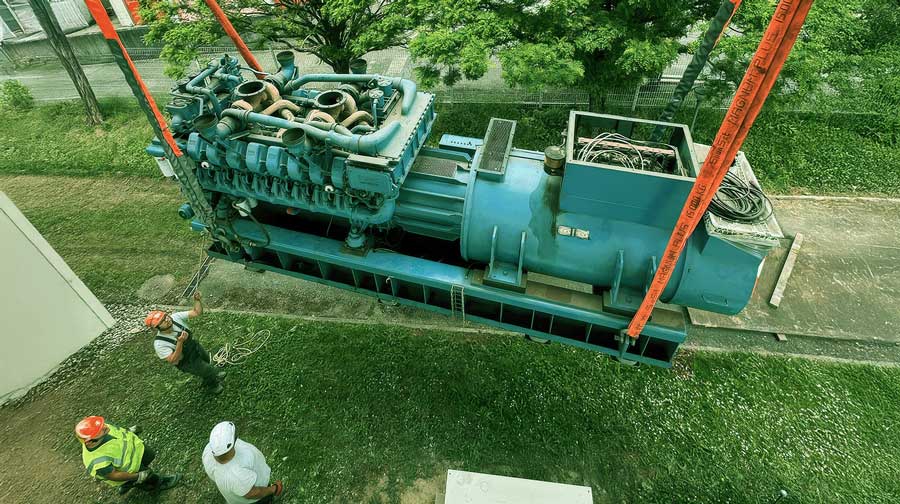
Through precise crane operations and careful handling, our team ensured the generators were extracted with minimal damage, preserving their most valuable components. What began as a vendor-led introduction evolved into a meaningful collaboration, with nLighten coordinating the logistics and SWISSAID ensuring the equipment reached those who needed it most.
This partnership transformed a technical upgrade into an act of solidarity, showing that sustainability is as much about people as it is about technology.
The Challenge: Removing Giants from the Underground
The core of the challenge lay beneath the surface. Three legacy generators, each weighing 25 tons, were installed in a cramped underground space surrounded by essential infrastructure such as ventilation systems and fuel tanks. Removing them wasn’t just a logistical puzzle; it was a balancing act between precision engineering and uninterrupted operations.
The original plan, inherited from the site’s previous owner involved dismantling the generators by cutting them into three pieces, a costly and environmentally taxing approach. Instead, our team proposed a bold alternative: break through the building walls, use hydroelectric skates to manoeuvre the generators to a shaft, and lift them out with a crane. This method minimised disruption and avoided unnecessary waste but demanded meticulous planning and execution.
A Small Team with a Big Vision
With just three core team members leading the project, the Geneva upgrade was a masterclass in resourcefulness. They navigated structural challenges with ingenuity, consulting experts when needed, installing support beams, and validating every step to ensure safety and compliance, all while keeping the goal in mind of sending the generators in a suitable condition so their spare parts could reach hospitals in Ukraine as part of a humanitarian partnership with SWISSAID.
Despite the complexity, the entire removal and replacement process was completed in just three weeks. Speed was essential: prolonged exposure to external elements could compromise both security and operations. Around the clock monitoring and reinforced security protocols ensured the site remained protected throughout.
Sustainability at the core
Environmental responsibility guided every phase of the Geneva project. All fluids and materials from the decommissioned generators were disposed of in full compliance with Swiss environmental regulations and nLighten’s own sustainability standards, ensuring zero contamination and minimal waste.
Though no longer operational, the units contained valuable spare parts for maintaining similar equipment still in use. By combining regulatory rigour with humanitarian purpose, the project demonstrated how sustainable engineering can deliver tangible social value. What might have been treated as waste became a vital source of support for hospitals operating under extreme conditions.
Smarter, Cleaner Technology
The Geneva upgrade wasn’t just about removing the old, it was about ushering in a new era of efficiency. The legacy rotary systems, which stored energy in constantly spinning mechanical wheels, were replaced with static UPS systems powered by batteries. These systems remain on stand-by until needed, significantly reducing energy consumption and improving overall efficiency.
This shift in technology opens the door to future possibilities. Battery-based systems could one day enable data centres like Geneva to activity support energy grids – storing power during low demand periods and supplying it during peak times. While this capability is not yet in place, it represents a promising direction for how data centres might evolve to contribute to broader energy resilience.
A blueprint for responsible transformation
The Geneva project reflects nLighten’s broader mission: to design and operate data centers that are not only high performing but also socially and environmentally responsible.
Through ingenuity, collaboration, and purpose, and in partnership with organisations like SWISSAID, we are proving that even the most technical challenges can become opportunities to do good.
What began as a logistical puzzle ended as a story of impact that bridges sustainability, innovation, and humanitarian action.